The sustainability reporting challenge
If you’ve ever felt overwhelmed by the alphabet soup of sustainability reporting requirements, you’re not alone. Organisations across industries face growing pressure to report on their environmental and social impacts across multiple, complex frameworks.
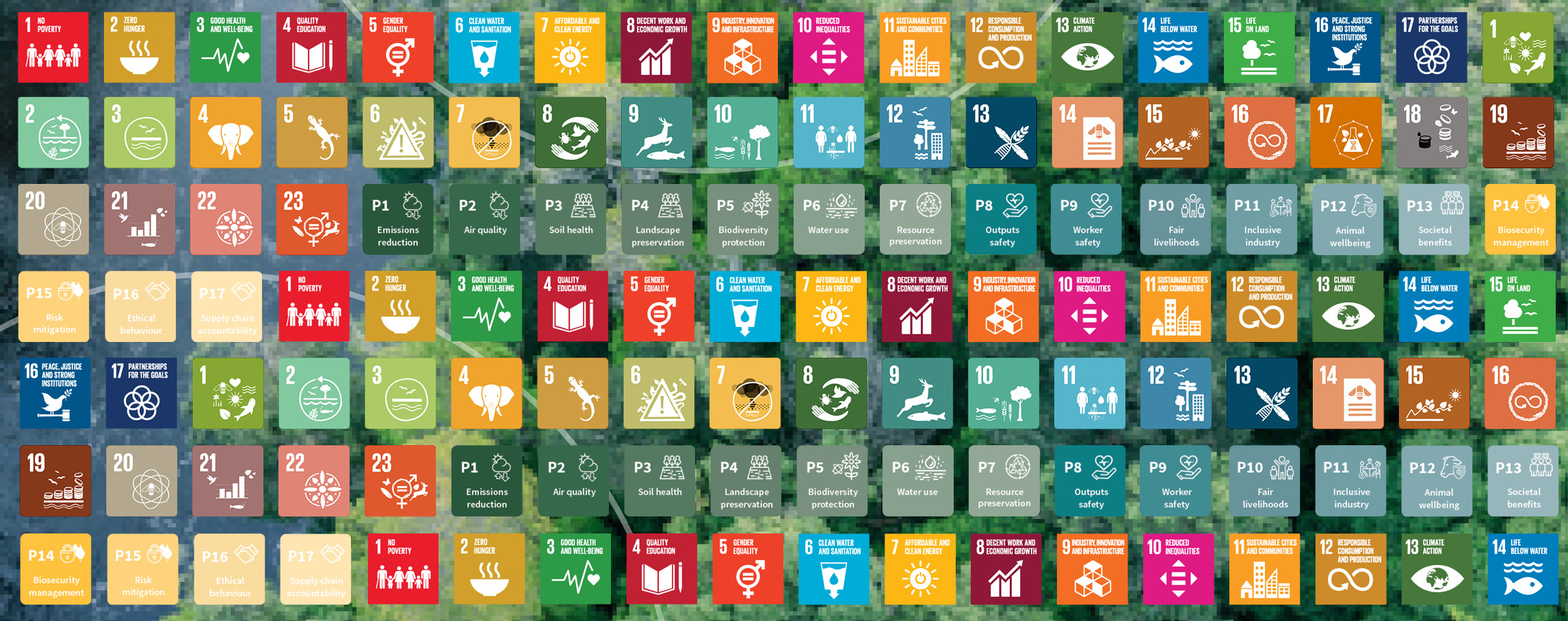
Sustainability reporting frameworks—including Environmental, Social and Governance (ESG), the Taskforce for Nature-related Financial Disclosures (TNFD), the UN Sustainable Development Goals (SDGs), the Kunming-Montreal Global Biodiversity Framework (GBF), and Australia’s Agricultural Sustainability Framework (AASF)—each provide different approaches to measure and improve performance.
The challenge? Navigating this maze creates significant obstacles:
- Each framework uses its own lens, language, and indicators
- Multiple frameworks make it difficult to choose which to prioritise
- Similar-but-not-identical indicators across frameworks complicate data translation
- Fragmented datasets prevent comprehensive reporting within single frameworks, let alone across multiple ones
The result? High reporting costs, duplicated effort, and confusion for investors, regulators, and communities.
How we overcame the challenge
When developing Natural Capital Suite’s reporting approach, we avoided choosing a single framework and tailoring our web apps to report only against its indicators. That approach would have locked us into one framework and limited our ability to serve broader needs.
Instead, we asked: “What really matters to natural resource managers?”
We reviewed strategic plans from NRM organisations across Australia, revealing recurring priorities that practitioners, landholders, and regional bodies care about most: soil health, water quality, biodiversity, climate resilience, cultural values, economic viability, and social outcomes.
From this review, we distilled 20+ core measures spanning environmental, social, economic, and governance domains. These measures reflect what NRM organisations are already working to achieve, giving Natural Capital Suite a practical, trusted foundation.
Next, we mapped these measures to globally recognised sustainability reporting frameworks. For example, a soil health indicator from an NRM plan can satisfy ESG disclosure requirements, map to TNFD impacts and dependencies, align with GBF targets, and demonstrate contribution to relevant SDGs.
This bottom-up approach enables Natural Capital Suite to overcome reporting challenges by:
- Focusing on real environmental and social outcomes valued by communities and landholders
- Avoiding framework-specific indicators that don’t translate across contexts
- Ensuring data is both locally relevant and globally recognised
How the mapping works
Think of Natural Capital Suite as a universal adapter:
Water quality improvement project outcomes map to:
- TNFD dependencies (surface water, water quality, erosion control) and impacts (freshwater and water pollutants)
- GBF targets 2 and 7 on ecosystem restoration
- SDG 6 (clean water and sanitation)
Landholder adoption of sustainable practices connects to:
- ESG governance indicators
- AASF farm-level metrics
- SDG 15 (life on land)
Regional nature repair investment planning links to:
- GBF Target 19 (mobilising financial resources)
- ESG sustainable finance disclosures
The case for Natural Capital Suite
Natural Capital Suite is an integrated collection of science-backed web apps for natural resource managers, nature repair project developers, landholders, and natural capital investors.
Web apps included in the Suite include:
Across Natural Capital Suite we have developed a common, data-driven foundation for sustainability reporting that:
- Measures what matters with 20+ indicators across environmental, social, economic, and governance dimensions
- Maps across frameworks by linking measures to ESG, TNFD, GBF, SDG, and AASF—making data work harder
- Standardises reporting to create consistent evidence demonstrating progress, performance, and impact


 https://truii.com/wp-content/uploads/2026/07/TN-Roadtrip-Cover-image.jpg
625
625
Tash Venz
https://truii.com/wp-content/uploads/2020/10/truii-full-colour-white.png
Tash Venz2026-07-08 13:36:172026-07-08 13:38:11Three cattle properties and a lot of dirt road—is there a real incentive for environmental reporting?
https://truii.com/wp-content/uploads/2026/07/TN-Roadtrip-Cover-image.jpg
625
625
Tash Venz
https://truii.com/wp-content/uploads/2020/10/truii-full-colour-white.png
Tash Venz2026-07-08 13:36:172026-07-08 13:38:11Three cattle properties and a lot of dirt road—is there a real incentive for environmental reporting?