Murray Darling Basin environmental watering performance
About 23% of the water assets in the Murray Darling Basin are assigned for use in meeting environmental outcomes. This is a huge public asset, with annual delivery managed through sophisticated planning and delivery processes focused on environmental priorities and annual water availability. However, performance reporting remains opaque, particularly in evaluating the effectiveness of annual environmental watering actions and the longer-term performance of the Basin Plan.
The core issue is that there is a mismatch between long-term flow planning metrics and operational reporting needs.
Bridging the gap between planning and reporting
Environmental Water Requirements (EWRs) are typically defined in Water Resource Plans as multi-parameter flow events—covering magnitude, duration, timing, frequency, and independence—framed for decadal evaluation (e.g., “3 events in 10 years”). While this supports the design of environmental watering regimes and the comparison of modelled scenarios, it falls short for:
- Annual planning
- In-season tracking
- End-of-year performance assessment
To bridge the gap, Truii has developed eFlow Projector, a data-driven web application that provides practical answers to essential operational questions. For example:
- To what extent did we meet our environmental watering objectives this season?
- Which EWRs were fully, partially, or not met at all?
- How did performance vary across the landscape?
- Which components of each flow rule (e.g., magnitude, duration, timing) contributed to the result?
- How much did managed environmental water contribute to achieving each outcome?
Continuous scoring: moving beyond binary metrics
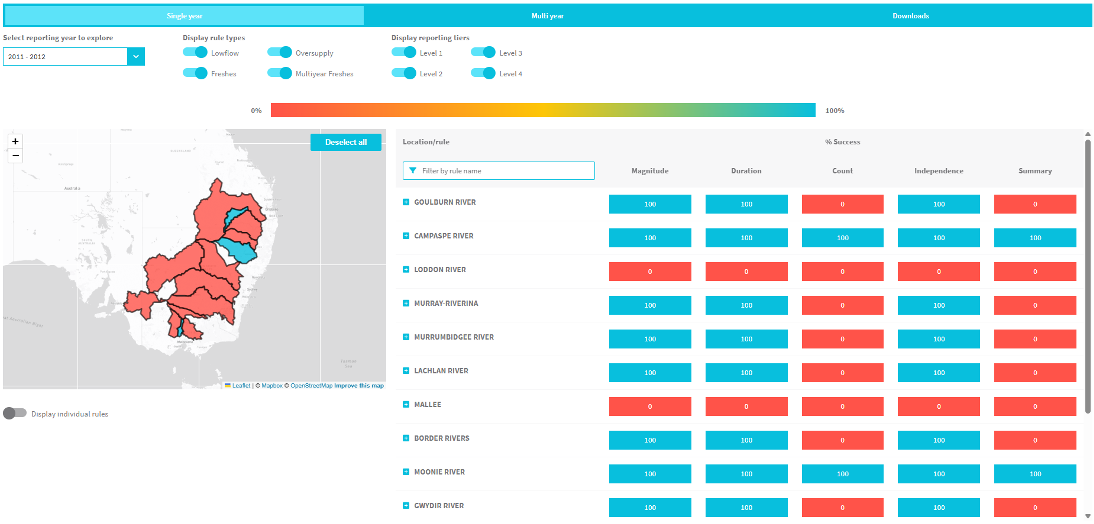
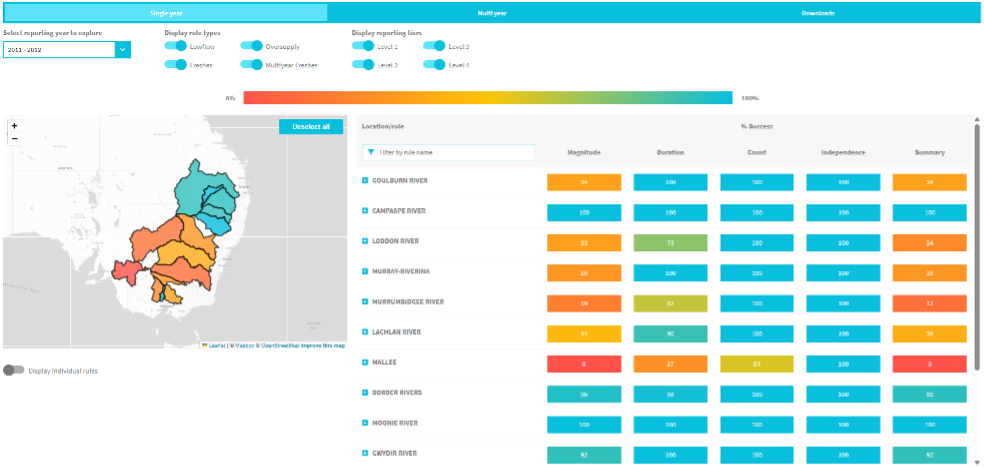
Traditionally, if an EWR failed to meet any of its parameters—e.g., magnitude slightly below target or timing off by one day—it was scored as a fail. However, ecological responses are rarely binary. Unlike traditional methods, eFlow Projector assesses flow targets on a continuous scale rather than a binary pass/fail. This means partial achievement—such as a slightly delayed event or lower-than-ideal magnitude—still contributes to the performance score, providing a more nuanced and ecologically realistic picture of what’s been delivered.
Murray Darling Basin example
To illustrate the continuous function/partial success approach in the Murray Darling Basin context, we have applied used eFlow Projector to create both a continuous scoring/partial success based scenario as well as a traditional binary approach scenario, and we apply both to 72 EWRs across 23 sites in the Basin as presented in Sheldon et al (2024).
Analysis set up
We have used the default partial success parameters for magnitude, duration, count and independence within the application, which have been developed through applying the Victorian Environmental Water Holder (VEWH) approach to planning several hundred EWRs across Victoria, including many that lie within Murray Darling catchments. Additionally, we have added a shoulder month to the ideal seasonal timing, whereby if an EWR occurs one month either side of the ideal timing it is worth 50% of the value of an event that occurs within the ideal timing window.
Results
eFlow Projector allows the compilation of EWRs into a ‘compliance report’ to report the collective performance across many catchments and EWRs within each catchment. The dynamic compliance reports can be filtered by location, EWR type and EWR importance. The images below (figures 1 and 2) show a simple snapshot for a single year (2011-12) between the binary and partial success/continuous scoring approaches.

 https://truii.com/wp-content/uploads/2024/08/EW-05-Cover-Image-New.jpg
1250
1250
Tash Venz
https://truii.com/wp-content/uploads/2017/11/truii-logo-full-colour.png
Tash Venz2025-09-25 10:17:482026-05-19 14:59:53How much of that eFlow success was due to effective water management?
https://truii.com/wp-content/uploads/2024/08/EW-05-Cover-Image-New.jpg
1250
1250
Tash Venz
https://truii.com/wp-content/uploads/2017/11/truii-logo-full-colour.png
Tash Venz2025-09-25 10:17:482026-05-19 14:59:53How much of that eFlow success was due to effective water management?