Environmental water prioritisation differs across the states
As part of its water planning cycle, to ensure that the needs of all water users and the environment, continue to be met, the Queensland Government reviews and replaces each of the state’s water resource plans on a 10-year cycle.
Water resource planning in Queensland differs to other states of eastern Australia, because Queensland generally doesn’t face heavily over-allocated systems (northern Murray Darling Basin being the exception) and has the luxury of considering the ecological implications of water resource development before an allocation for consumptive use is provided. The difference is that other eastern states are busily clawing back water and managing environmental releases from storages in over-allocated systems while Queensland considers the environmental requirement first before allocating for consumptive use.
Despite the differences in the order of priority for allocations between Queensland and the other eastern states, there is still a common challenge to overcome — how to quantify the ecological consequences of water use?
How to quantify the ecological consequences of water use
So, how does one consider the ecological implications of water use (potential or actual)?
Truii’s approach has been to focus on defining the hydrological component of habitat requirements and to compare the habitat change of alternative water use scenarios.
The commonly used environmental water requirements used in southern states are represented as flow rules in eFlow Projector.
Queensland’s approach takes this a step further by considering the specific water requirements of individual species or processes.
For example, the basic definition of freshes (magnitude, duration, timing, count) doesn’t capture the nuance of the endangered Mary River turtle (Elusor macrurus), which requires a fresh (flow pulse) or rainfall event to provide initial conditions for egg laying, followed by an event within the egg aestivation (dormancy) period.
Use Eco Risk Projector
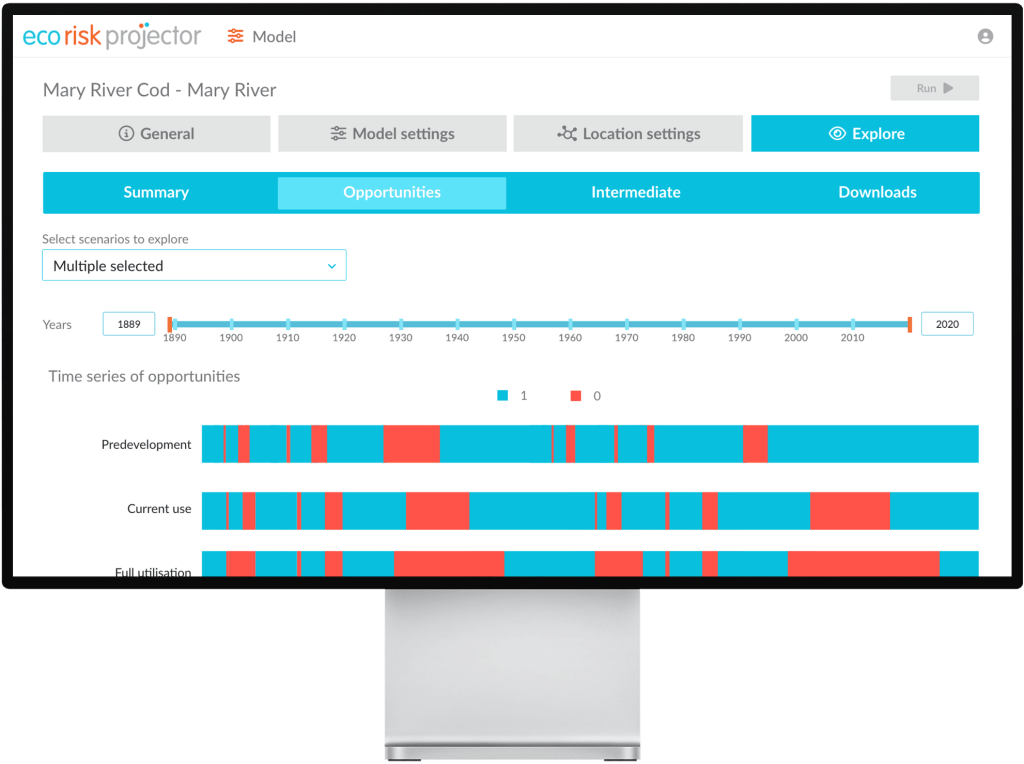
We created Eco Risk Projector to capture species level flow-habitat models. Eco Risk Projector is an open-source Python-based modelling framework that allows for the rapid creation of new flow-habitat models. In addition to the Python computation engine, Truii has created a web interface, which allows users to:
- utilise Eco Risk Projector’s more than 30 flow-habitat models for predicting changes in habitat suitability under different water resource use scenarios;
- explore and visualise model results as location-based opportunities (success and failure) of species, assets and processes under different water use scenarios; and
- store data and manage libraries of data and parameterised models.
Assessing risk across multiple sites
A further advancement developed by the Queensland Government is to quantify the importance of spatial patterns and connectivity in assessing flow-habitat results.
For example, consider the implications of multiple simultaneous failures across the landscape such as all waterholes becoming dry in the same year, which could cause a local extinction event because there is no refuge available for recolonisation once the waterholes refill.
Eco Risk Projector allows you to spatially combine site-based flow-habitat assessments to create overall system-level risk assessments for each water use scenario. These scenario-specific, system-level risk assessments can then be compared to inform water planning.
Learn more about Eco Risk Projector >>


 https://truii.com/wp-content/uploads/2024/08/EW-05-Cover-Image-New.jpg
1250
1250
Tash Venz
https://truii.com/wp-content/uploads/2017/11/truii-logo-full-colour.png
Tash Venz2025-09-25 10:17:482026-05-19 14:59:53How much of that eFlow success was due to effective water management?
https://truii.com/wp-content/uploads/2024/08/EW-05-Cover-Image-New.jpg
1250
1250
Tash Venz
https://truii.com/wp-content/uploads/2017/11/truii-logo-full-colour.png
Tash Venz2025-09-25 10:17:482026-05-19 14:59:53How much of that eFlow success was due to effective water management?