Traditional spell analysis approach
Environmental watering requirements are typically described as a combination of characteristics of the hydrologic regime (timing, magnitude, duration, independence, frequency, count).
To assess the performance of the environmental watering requirement, we typically conduct a ‘spell’ analysis.
A spell analysis is traditionally driven entirely by counting exceedance of a flow threshold. A spell starts when the magnitude threshold is reached, and a count of duration is applied until the flow falls below the threshold.
This approach works fine when the threshold is an absolute value such as flow required to reach a wetland fill level. However, it fails for instream flow, when the desired flow is within a range, such that some flow is good but more is better.
We broke the spells approach
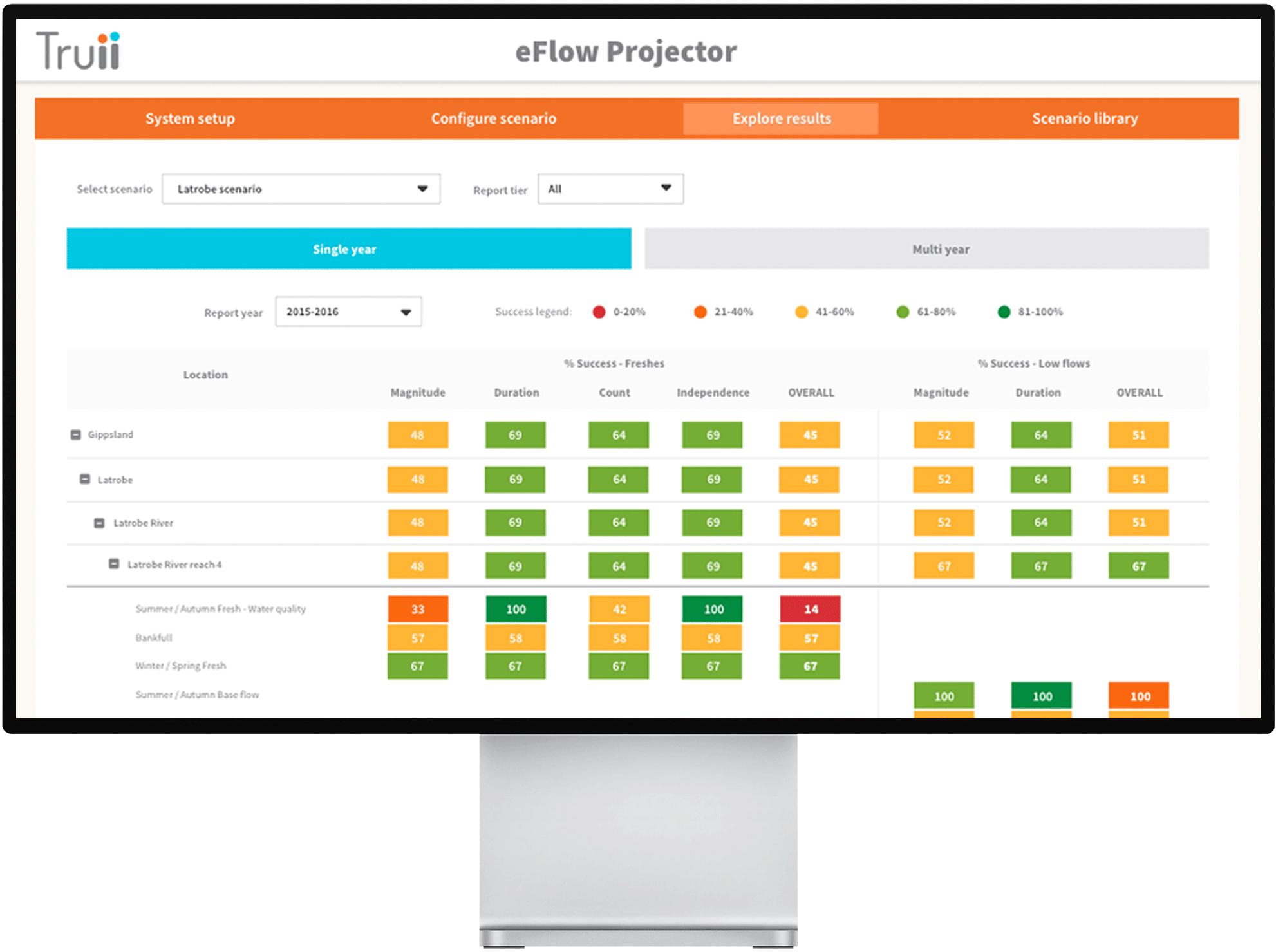
In eFlow Projector, we created the ability to account for variable flow characteristics. For example, if the target threshold is 50ML/day, but a flow of 45ML/day will achieve 80% of the objectives, we no longer have a fixed magnitude threshold on which to base the spell analysis (see our story on reporting partial success).
With a variable flow threshold, the traditional spells approach to assessment no longer works because there isn’t a simple start and end to a flow spell.
Then we fixed it
Our approach to the variable flow threshold is to capture all the days above the minimum possible flow that could provide some value. This collection of days we term the ‘event opportunity’.
eFlow Projector then considers each collection of sequential days within the event opportunity to select the best subset of days to describe as the event from which a performance score is determined.
The basic concept is simple enough, but the trick is in determining a consistent way to end the event opportunity when a large range of flow can provide some value.
For example, a flow above 10ML/day may provide some water quality benefit, however the ideal threshold is 50ML/day. 10 ML/day is reasonably low flow, and the discharge may stay above this level for most of the wet season with several flushes occurring throughout that potential period.
To handle this case, eFlow Projector looks at points of inflection to determine if the flow has stopped falling, and begins to rise, signifying the end of an event opportunity and the start of another.
On this basis, eFlow Projector defines a collection of event opportunities within a season, where those even opportunities start from the minimum flow that could provide value and end when this low threshold is again crossed, or there is an upward inflection signifying a secondary flush.
Each of the event opportunities is analysed to see which provides the best overall series of consecutive days to provide the best magnitude score. Event opportunities are then ranked on this event opportunity score.


 https://truii.com/wp-content/uploads/2024/08/EW-05-Cover-Image-New.jpg
1250
1250
Tash Venz
https://truii.com/wp-content/uploads/2017/11/truii-logo-full-colour.png
Tash Venz2025-09-25 10:17:482026-05-19 14:59:53How much of that eFlow success was due to effective water management?
https://truii.com/wp-content/uploads/2024/08/EW-05-Cover-Image-New.jpg
1250
1250
Tash Venz
https://truii.com/wp-content/uploads/2017/11/truii-logo-full-colour.png
Tash Venz2025-09-25 10:17:482026-05-19 14:59:53How much of that eFlow success was due to effective water management?