Home > Stories > Environmental water > Reporting the performance of environmental watering

Reporting the performance of environmental watering

Summary

Environmental watering requirements are defined for a gauge or reach. When reporting on environmental watering performance across a region or basin there are tens or hundreds of environmental water requirements to analyse.

Truii’s eFlow Projector web application uses a hierarchical aggregation approach to allow rapid exploration of environmental watering performance across regions, basins, catchments, sub-catchments, and by site.

waterfall

5 min read

Author: Nick Marsh

Why assess flow rules individually, when you can assess everything, everywhere, all at once?

There are around 800 environmental watering requirements to keep track of each year across the Murray Darling Basin and about 400 reported across Victoria. Whilst each environmental watering requirement can be investigated individually, it is important to be able to aggregate their performance spatially to understand the system wide implications.

eFlow Projector reporting works on so many levels

Truii has created eFlow Projector a web application that analyses and reports the performance of individual flow requirements. When considering multiple requirements at a site, and multiple sites across a region it is essential to be able to aggregate these results to see the bigger picture.

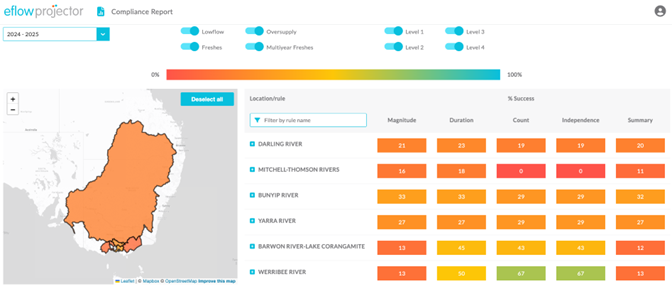
Using the design concept of ‘progressive disclosure’ eFlow Projector includes aggregated reporting to get an overall performance score for a reporting region (Figure 1).

Figure 1: Region level summary reporting

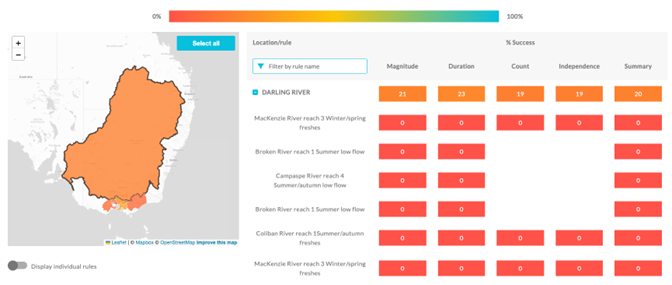
These region level scores can be expanded to get summary reporting at the catchment, sub-catchment, and river reach scales and ultimately to explore the performance of every one of the environmental water requirements being assessed (Figure 2).

Figure 2: Explore results at different spatial scales

This next level of reporting is not simply at for overall flow rule performance, it can then be expanded further to see reporting for the components of the flow regime used to describe each flow rule (typically magnitude, duration, count and independence).

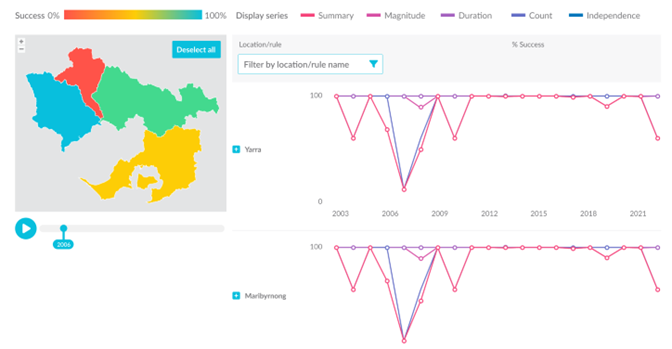
Furthermore, eFlow Projector allows the visual exploration of these different spatial scales through time (Figure 3). This is particularly useful when conducting historical analysis of past performance and can explain patterns of poor recent performance compared to historical performance.

Performance Reporting
Figure 3: Temporal presentation of spatial aggregation for performance reporting

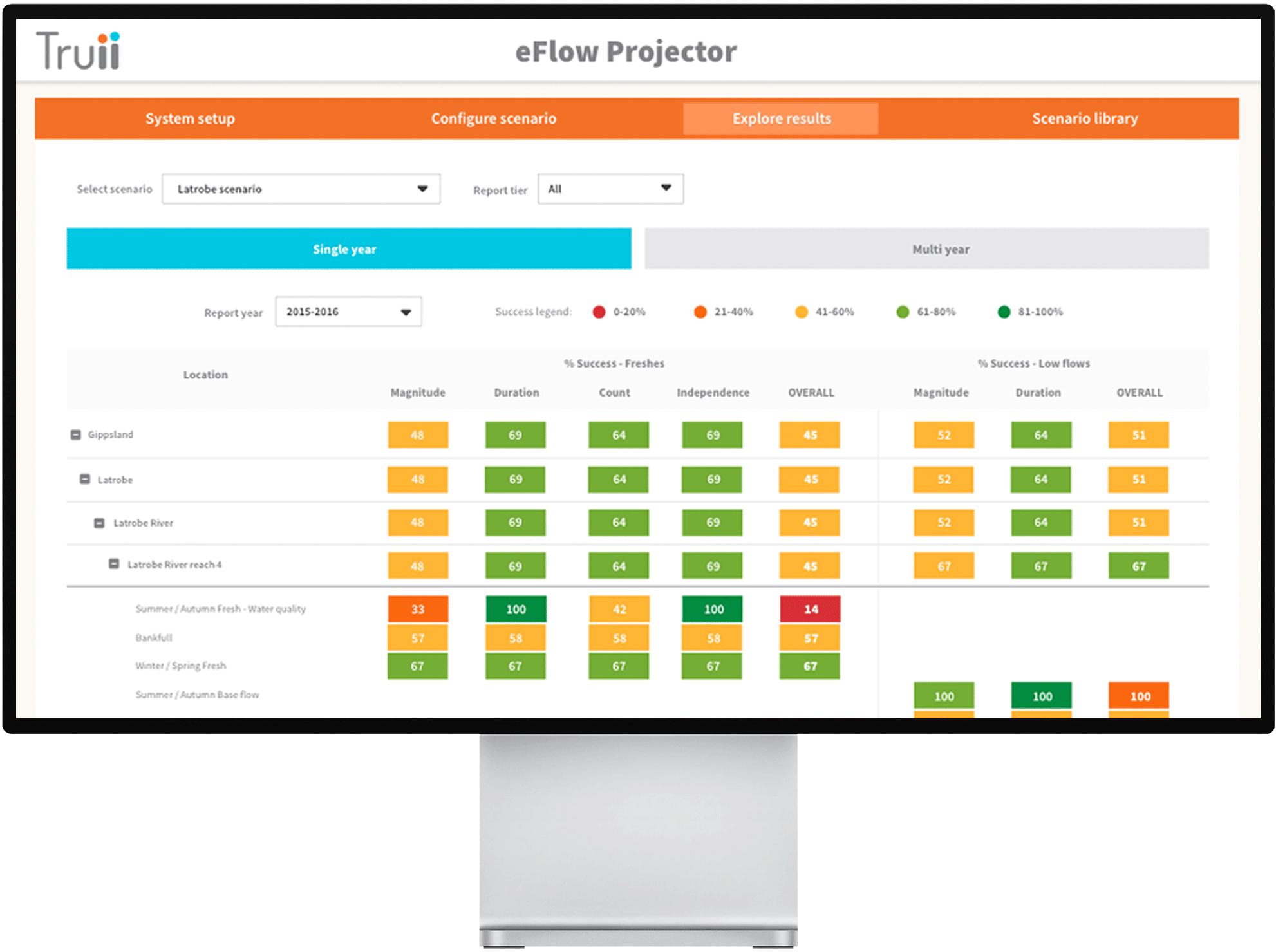
A further level of reporting is provided in eFlow Projector through the creation of ‘performance reports’. The performance report approach allows the creation of custom sets of flow rules for targeted reporting, which could be used to report:

  • all the high flow rules which may target wetlands
  • low flow rules which target water quality
  • intermediate flow rules which may be used to trigger fish movement or spawning
  • flow rules managed by a single water scheme operator.
eFlow-Projector-desktop

Read similar stories